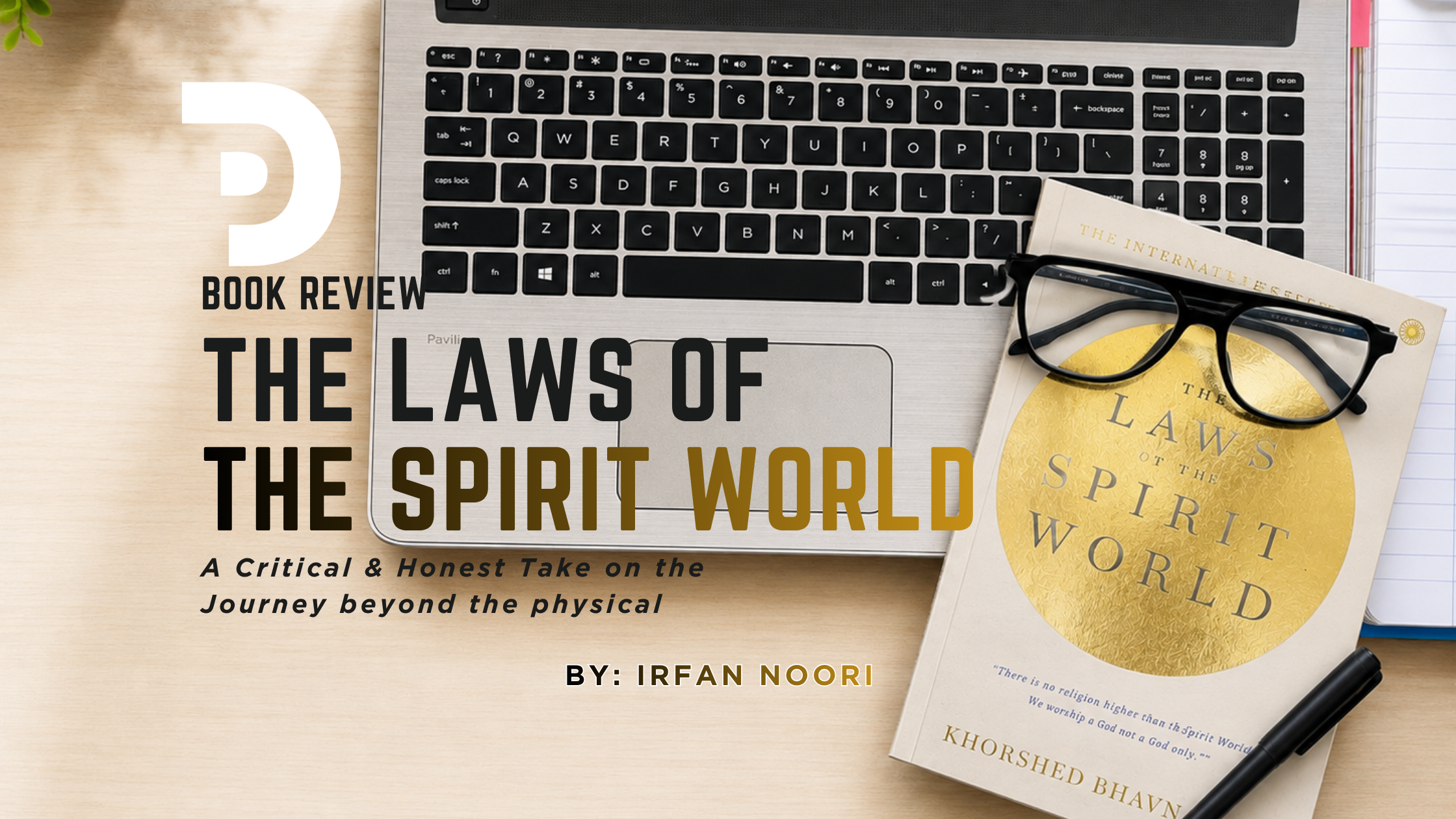
The Laws of the Spirit World Review:
Comforting Moral Wisdom or an Unconvincing Map of the Afterlife?
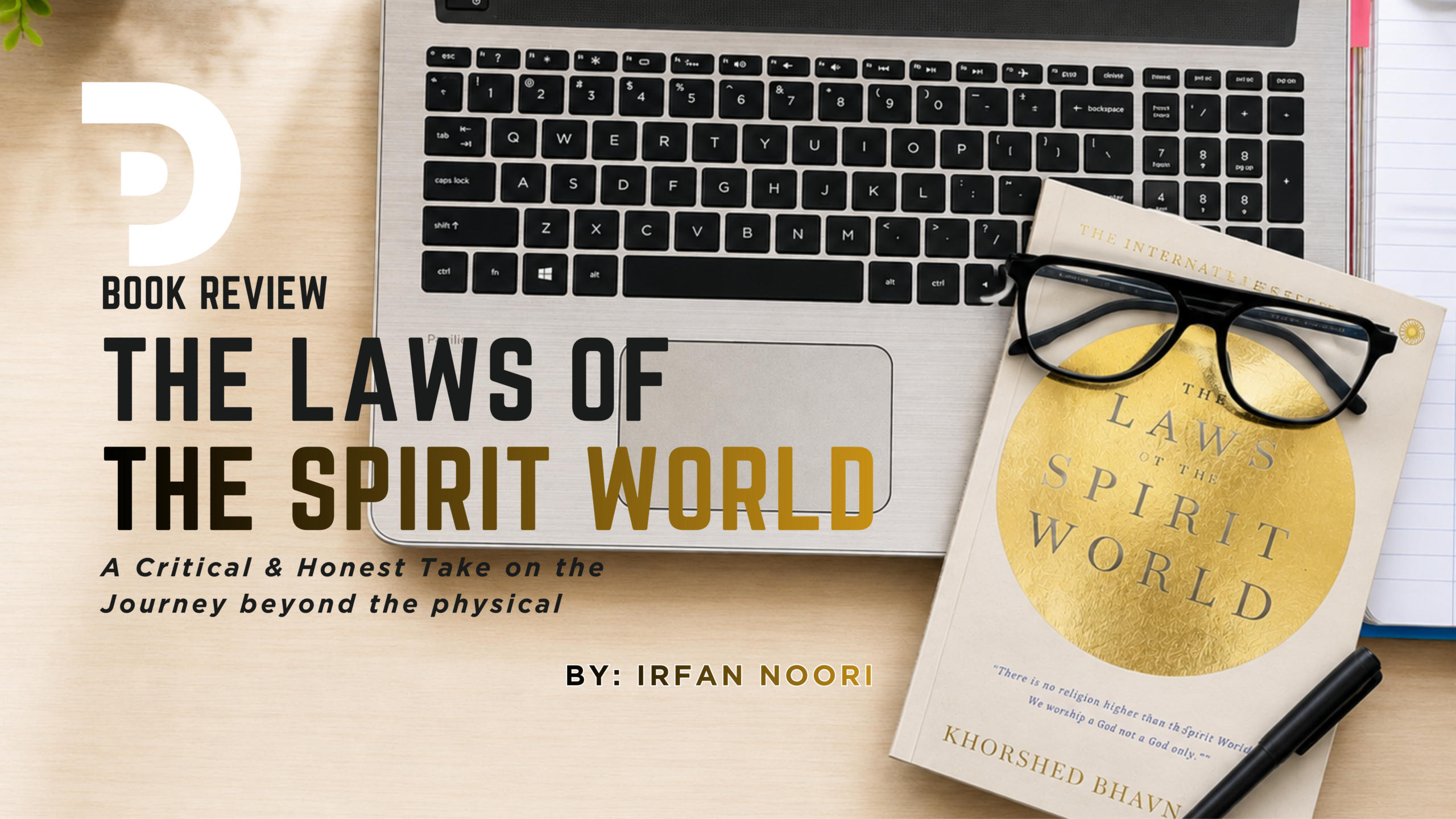
Some books challenge your beliefs. Some expand them. Others make extraordinary claims and then ask you to accept those claims largely because the book itself says they are true.
Khorshed Bhavnagri’s The Laws of the Spirit World belongs to the third category.
I began reading it with genuine curiosity.
This was not an attempt to mock spirituality, reject the possibility of an afterlife or dismiss a grieving mother’s experience. The origin of the book is deeply tragic and deserves sensitivity. Khorshed and Rumi Bhavnagri lost both their sons, Vispi and Ratoo, in a car accident in 1980. According to the book, the parents later contacted them through mediums and eventually through automatic writing.
The messages attributed to the brothers became the foundation of The Laws of the Spirit World.
The book presents itself not merely as personal reflection but as information communicated from the afterlife. It describes God, karma, reincarnation, spirit guides, the subconscious mind and a detailed system of seven spiritual realms.
That distinction matters.
A personal spiritual belief can be meaningful without being proven. But once a book claims to explain the actual architecture and laws of existence, it should be possible to examine its consistency, reasoning and supporting evidence.
After reading the complete book, my conclusion is divided.
Its moral teachings are often humane and worth considering. Its emotional origin appears sincere. But its elaborate description of the spirit world is unsupported, internally unstable and, in several places, ethically troubling.
This is not a review written to attack believers. It is an attempt to separate emotional value, moral value and factual credibility, three things that spiritual literature frequently blends together because apparently one category was not complicated enough.
The Short Verdict
The Laws of the Spirit World is most effective when read as:
- a grieving family’s search for meaning;
- a collection of moral teachings;
- a spiritual framework for coping with death;
- a series of parables about honesty, responsibility and kindness.
It is far less convincing when read as:
- factual evidence of communication with the dead;
- an accurate map of the afterlife;
- a reliable explanation of karma and suffering;
- a consistent account of reincarnation and divine justice;
- proof that seven spiritual realms objectively exist.
The book may offer comfort to readers who already believe in life after death. Readers seeking evidence, philosophical depth or logical consistency will probably find it difficult to accept.
What Is The Laws of the Spirit World About?
The book is attributed to messages received by Khorshed Bhavnagri from her deceased sons, Vispi and Ratoo.
According to the preface, the family first attended a séance after the deaths of the two brothers. A medium reportedly used a private nickname that Vispi had used for his mother. This convinced Khorshed and Rumi that the communication was genuine.
The parents later began communicating through automatic writing. Khorshed would hold a pen while concentrating, and the movement of her hand was believed to be guided by her sons. The book says the early attempts produced scratches before gradually forming words and complete answers.
The messages cover several subjects:
- the nature of God;
- the difference between good and evil;
- karma and moral responsibility;
- reincarnation;
- the seven realms of the spirit world;
- communication with departed souls;
- the purpose of suffering;
- spirit guides and twin souls;
- prayer, pride, revenge and suicide;
- the role of the subconscious mind;
- the supposed purpose of life on Earth.
The book claims that the brothers received permission from higher spiritual beings to communicate these laws for the benefit of humanity. At the same time, it says these teachings should not be forced upon anyone.
The Emotional Foundation of the Book
Before examining its claims, it is important to recognise the human story behind the book.
Khorshed and Rumi Bhavnagri lost both sons in the same accident. The book describes Khorshed as emotionally devastated and ready to abandon her faith in God.
Communication with Vispi and Ratoo gave the parents a way to continue their relationship with their sons. It also gave their grief a larger purpose.
They began helping other people who had lost family members. The book says that reducing the suffering of others also reduced their own pain. This may be the most believable and emotionally valuable part of the entire account.
Whether or not the communications came from departed souls, the belief clearly helped the family transform grief into service.
That deserves respect.
However, emotional sincerity does not establish supernatural accuracy.
A person can honestly believe an experience is spiritual while other explanations remain possible. Grief, subconscious thought, expectation, memory and involuntary hand movements can all produce experiences that feel external to the person having them.
This does not mean Khorshed deliberately invented the messages.
It means sincerity and objective truth are not the same thing.
The Seven Realms of the Spirit World
The best-known part of the book is its description of seven realms, each divided into ten stages.
According to the text:
- Realms 1, 2 and 3 represent progressively less severe forms of hell.
- Realm 4 is an intermediate plane containing both good and negative qualities.
- Realm 5 is described as the beginning of heaven.
- Realm 6 is a beautiful, harmonious and highly developed spiritual plane.
- Realm 7 is the highest realm described in the book.
The lower realms contain darkness, deformity, hatred and suffering. The higher realms contain light, beauty, harmony and increasingly purified souls.
The brothers describe being welcomed by relatives and higher souls after their death. They are taken to a Hall of Rest, where they sleep and recover from the shock of suddenly leaving their physical bodies. The book later explains that Vispi and Ratoo were on Realm 6 in 1981 and says they reached Realm 7 in 1985.
To be fair to the book, it does not say that the brothers began in the lowest realm and immediately jumped to Realm 7. That would be an inaccurate criticism.
The larger problem is different.
The book gives extremely precise details about the spirit world without demonstrating how any of them can be independently confirmed.
Why seven realms?
Why ten stages within each realm?
How are spiritual positions measured?
Who verifies whether a soul is at Realm 6, Stage 7 rather than Realm 6, Stage 6?
Why would a non-physical universe use a numerical hierarchy that resembles a human administrative system?
The book answers these questions by referring to higher souls, spiritual rulers and divine laws. But those answers depend entirely upon accepting the system the book is trying to prove.
The Spirit World Resembles a Human Bureaucracy
The afterlife described in the book contains:
- rulers of individual realms;
- a supreme ruler of Realm 7;
- permissions for travel;
- spiritual work assignments;
- protective cloaks;
- training procedures;
- halls for rest and education;
- authorised communication;
- restricted knowledge;
- spiritual guides;
- stages of advancement;
- rules for appeals and intervention.
It is strangely administrative.
The world described is less like an unknowable spiritual dimension and more like an eternal government department with pleasant gardens on the upper floors.
This does not automatically prove the system is imaginary. Human language may be unable to describe spiritual experiences without using familiar structures.
But the book never acknowledges that these descriptions might be metaphors.
Instead, it presents them as literal information about the organisation of the afterlife. That level of certainty requires considerably stronger evidence than automatic writing and personal testimony.
What the Book Gets Right
Despite its credibility problems, the book contains several worthwhile moral ideas.
Motive matters more than appearance
One of its strongest teachings is that public generosity does not necessarily make someone good.
The book repeatedly argues that charity performed for praise, status or entry into heaven is not truly selfless. A person may appear religious and respectable while privately acting with cruelty, dishonesty or selfishness.
That is a sensible observation.
Goodness cannot be measured only by rituals, donations or reputation. The intention behind an action matters.
Personal responsibility matters
The book encourages readers to examine themselves rather than blame God, priests, society or other people for every wrongdoing.
Its repeated message is that individuals must acknowledge their mistakes, genuinely repent and change their conduct.
Again, this is not revolutionary spiritual information. Any person with a functioning conscience could reach a similar conclusion. But ordinary wisdom does not become less valuable merely because it is ordinary.
Religious identity does not guarantee morality
The book is critical of people who pray regularly, visit religious institutions and display piety while behaving selfishly.
It argues that no priest, ritual or donation can erase deliberate harm without sincere remorse and corrective action.
This is one of the book’s more useful messages for societies where public religiosity and private conduct often appear to have entered separate business partnerships.
Self-analysis is valuable
The book asks readers to review their motives, pride, jealousy, anger and treatment of others.
Even a sceptical reader can use these sections constructively.
We do not need to believe in seven realms to examine whether our kindness is genuine, whether our pride harms others or whether our public image differs from our private behaviour.
Why the Moral Lessons Do Not Prove the Spirit World
The ethical advice in the book is often presented as evidence of higher spiritual communication.
But good advice does not prove a supernatural source.
“Be honest.”
“Do not harm others.”
“Control greed and jealousy.”
“Help people selflessly.”
“Take responsibility.”
“Do not seek revenge.”
These principles appear in nearly every major religious and philosophical tradition. They also appear in secular ethics and basic human decency.
A book can contain useful moral lessons while its supernatural explanation remains unproven.
This is the most important distinction in reviewing The Laws of the Spirit World.
We can preserve the advice without accepting the cosmology.
The Problem of Internal Consistency
The book establishes many rules about what happens after death, but its own stories do not always follow them cleanly.
The confused old man
One early story describes the brothers encountering an elderly newcomer beside a brook.
The man does not realise he has died. He believes he has arrived at a holiday destination and asks for directions to his earthly home. The brothers and several higher souls eventually explain where he is.
This creates questions.
The book elsewhere describes relatives welcoming newly arrived souls, higher beings assisting them and sudden-death victims being taken to a Hall of Rest.
Why was the old man wandering without guidance?
Why had he not been taken to the Hall of Rest?
Why had no assigned guide explained his condition?
Why did help depend upon a chance encounter with Vispi and Ratoo?
Possible explanations can be invented, but they are not supplied by the story. A reader should not have to repair the spiritual system on the author’s behalf.
Flexible rules of advancement
At different points, the book says spiritual progress is extremely slow in the spirit world but can also happen rapidly through genuine repentance.
Souls may spend centuries in lower realms, yet some can rise considerably within a relatively short period.
The system can accommodate almost any outcome because progress depends upon sincerity, karma, subconscious development, permission, free will and spiritual assistance.
Since none of these factors can be objectively measured, any apparent contradiction can be explained after the event.
The subconscious mind
The book describes the subconscious mind as the eternal, true spiritual self. It allegedly knows previous lives, records every action, warns against wrongdoing and produces karmic justice.
But it can also become dormant, fail to guide a person or be overpowered by the physical mind.
The Q&A section says the physical mind is rational while the subconscious mind provides spiritual guidance. It even suggests that conflict between logical reasoning and subconscious instruction should be settled in favour of the subconscious mind.
This is problematic.
A moral intuition can be valuable, but intuition is not automatically correct. Fear, prejudice, trauma and wishful thinking can also feel deeply intuitive.
Teaching people to distrust rational examination whenever it conflicts with an inner impression can encourage certainty without evidence.
A Belief System That Cannot Be Disproved
The book creates explanations for nearly every possible result.
If spirit communication succeeds, that confirms the spirit world.
If it fails, the person may lack concentration, faith, spiritual development or authorised guidance.
If someone suffers, the cause may be karma, a previous life, a chosen spiritual test or another person’s free will.
If someone receives help, it proves divine guidance.
If help does not arrive, the difficulty may be necessary for spiritual growth.
If a prediction is correct, the spirits knew it.
If it is incorrect, free will changed the future.
A claim that can explain every possible result cannot easily be tested.
This does not mean it must be false. It means the book provides no reliable method for determining whether it is true.
The reader is asked to trust the messages because the messages claim spiritual authority. That is circular reasoning.
“No Religion” Yet a Complete Religious System
The book repeatedly states that there is no religion in the spirit world and that all souls worship one God.
However, the system includes:
- God;
- sin;
- heaven and hell;
- prayers;
- spiritual rulers;
- karma;
- reincarnation;
- purification;
- divine missions;
- higher souls;
- moral laws;
- advancement towards God.
This is clearly a religious worldview.
What the book probably means is that the spirit world contains no separate organised religions or sectarian identities.
That would be a reasonable distinction.
But saying there is “no religion” while presenting a complete theological system is misleading. The book rejects existing religious institutions and then constructs another spiritual hierarchy of its own.
Karma, Justice and the Moralisation of Suffering
The book’s treatment of suffering is among its most serious weaknesses.
It frequently explains hardship through:
- punishment for past actions;
- karma from previous lives;
- spiritual training;
- chosen suffering;
- the need to purify the soul;
- another soul’s misuse of free will.
This may comfort some readers by suggesting that suffering is never meaningless.
But it can also create a dangerous tendency to assume that victims somehow chose, deserved or spiritually required their suffering.
A person experiencing abuse, illness, poverty, disability or injustice needs compassion and practical support. They do not need strangers speculating that an unknown previous life created their pain.
The language of karma can become an elegant way of blaming people for circumstances we do not understand.
Any spiritual interpretation of suffering should therefore be approached with humility, not certainty.
The Book’s Treatment of Suicide
The book calls suicide a sin and presents it as a spiritual failure that leads to further suffering.
This is one of its most troubling teachings.
People who die by suicide are often experiencing severe psychological distress, trauma, mental illness or impaired judgment. Describing them primarily as selfish or spiritually weak oversimplifies a complex human tragedy.
Fear of spiritual punishment is not a responsible substitute for mental-health support.
A person in crisis needs safety, professional care, compassion and human presence. Moral condemnation can increase shame and discourage people from seeking help.
The book may intend to protect life, but intention does not erase the possible harm caused by its language.
Automatic Writing Is Not Evidence by Itself
Automatic writing refers to writing produced without the writer consciously directing every movement or sentence.
The book treats this process as communication from departed souls. Its disclaimer also describes automatic writing as material originating from the spirit world and warns readers not to attempt it without authorised supervision.
However, the experience of involuntary writing does not by itself establish an external spiritual source.
Possible explanations include:
- unconscious thought;
- the ideomotor effect;
- expectation;
- memory;
- emotional suggestion;
- dissociation;
- creative composition outside deliberate awareness.
The book does not present controlled tests capable of distinguishing spirit communication from these possibilities.
There are no complete records of successful and unsuccessful messages, no blinded verification process and no independent method for confirming the identity of the alleged communicators.
The private nickname used by the medium was emotionally persuasive to the family. But one striking personal incident is not sufficient to establish an entire seven-realm system governing all human existence.
The Disclaimer Creates an Awkward Contradiction
The book speaks confidently about the real laws of God, karma, reincarnation, death and the structure of the spirit world.
Yet its closing disclaimer gives no assurance regarding the accuracy, completeness, timeliness or fitness of the messages.
The organisation associated with the book also accepts no responsibility for actions readers may take based on the material.
Legally, this may be understandable.
Intellectually, it creates a problem.
A book cannot easily claim to reveal the true laws of existence while simultaneously declining to assure readers that those messages are accurate.
The result is a peculiar arrangement: absolute spiritual certainty throughout the book, followed by complete institutional uncertainty at the end.
Is the Book Fabricated?
There is no sufficient basis to accuse Khorshed Bhavnagri of consciously inventing the entire account.
She may have sincerely believed that the messages came from her sons.
The emotional conditions surrounding the experience were intense. She had lost both children suddenly and was searching for meaning, connection and relief from unbearable grief.
Automatic writing may have felt completely external to her conscious mind.
Therefore, the fairest conclusion is not that the book is necessarily a deliberate fraud.
The fairer conclusion is:
The experiences may have been sincere, but the book does not provide enough evidence to establish that its supernatural interpretation is objectively true.
That distinction protects compassion without abandoning critical judgment.
Who May Find This Book Meaningful?
The book may appeal to readers who:
- already believe in reincarnation and life after death;
- have lost loved ones and seek reassurance;
- prefer simple moral teachings;
- are comfortable accepting spiritual testimony without empirical proof;
- view karma as a meaningful explanation for life events.
It may disappoint readers who:
- expect philosophical depth;
- want consistent world-building;
- require evidence for supernatural claims;
- are uncomfortable with suffering being explained through karma;
- prefer psychological or scientific approaches to grief and consciousness;
- question spiritual authority rather than accepting it.
Is The Laws of the Spirit World Worth Reading?
That depends upon how it is read.
As a factual guide to the afterlife, I would not recommend accepting it uncritically.
As a human story about grief, faith and the attempt to find meaning after devastating loss, it is worth understanding.
As a collection of moral reminders, it contains several ideas worth retaining:
- be honest with yourself;
- examine your motives;
- avoid cruelty and revenge;
- do not mistake public reputation for goodness;
- help others sincerely;
- take responsibility for your actions.
None of these lessons requires belief in spirit communication.
Readers can accept what is ethically useful while questioning everything presented as supernatural fact.
Final Verdict
The Laws of the Spirit World begins with genuine human tragedy and offers a spiritual system that clearly brought comfort to the Bhavnagri family and many of their followers.
That emotional impact should not be dismissed.
The book encourages kindness, self-analysis, responsibility and service. These are valuable messages.
But its detailed supernatural claims are not supported by verifiable evidence. Its rules frequently depend on explanations that cannot be tested. Some stories create continuity problems, and its treatment of karma, suffering and suicide deserves serious criticism.
The book is therefore best understood as a work of spiritual belief and grief-driven meaning-making, not as an established account of life after death.
My Assesment:
| Area | Rating |
|---|---|
| Emotional sincerity | 4/5 |
| Moral usefulness | 3/5 |
| Writing and storytelling | 2.5/5 |
| Internal consistency | 1.5/5 |
| Evidentiary credibility | 1/5 |
| Overall | 2/5 |
This is not because spirituality must be rejected.
It is because extraordinary claims should not become immune to ordinary questions.
Faith may offer comfort. Reason helps prevent comfort from becoming certainty without evidence.
A mature reader should be capable of holding both ideas at once.
For the PatnaDiaries audience, perhaps that is the most useful takeaway: we do not have to ridicule someone’s faith to examine their claims honestly, and we do not have to surrender critical thinking merely to prove that we are open-minded.
Respect the grief.
Retain the humane lessons.
Question the certainty.